
What is Local Law 97?
1
Sets carbon caps for buildings over 25,000 square feet
3
Allows multiple ways to comply, including for affordable housing
2
Began in 2024 and drives toward net zero emissions by 2050
4
Includes large fines for exceeding carbon caps
50,000
buildings
60%
of NYC’s building area
50%
of NYC building emissions
In 2024, Local Law 97 went into effect in New York City, placing carbon caps on most buildings larger than 25,000 square feet. The law passed in 2019 to drive deep emissions cuts from buildings, which are responsible for more than two-thirds of NYC’s greenhouse gas emissions.
Today, the nearly 50,000 properties covered by Local Law 97 are taking steps to meet the law’s charge. It is the most ambitious building emissions legislation enacted by any city in the world, and it’s design incorporates many recommendations from Urban Green’s 80×50 Buildings Partnership.
Local Law 97 phases in carbon caps through 2050
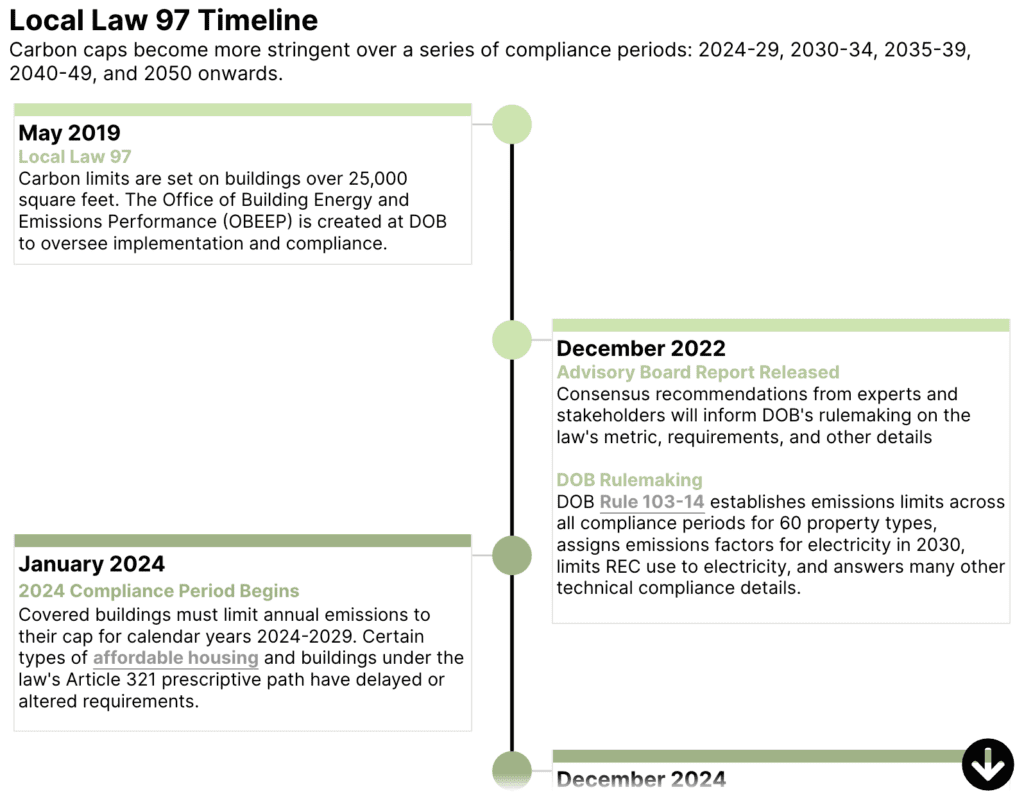
The law began phasing in carbon caps for large buildings in 2024, and those limits will become more stringent over a series of compliance periods through 2049. In 2050, all buildings will have to meet zero emissions requirements. Explore Local Law 97’s timeline below.
Carbon caps vary across 60 property types
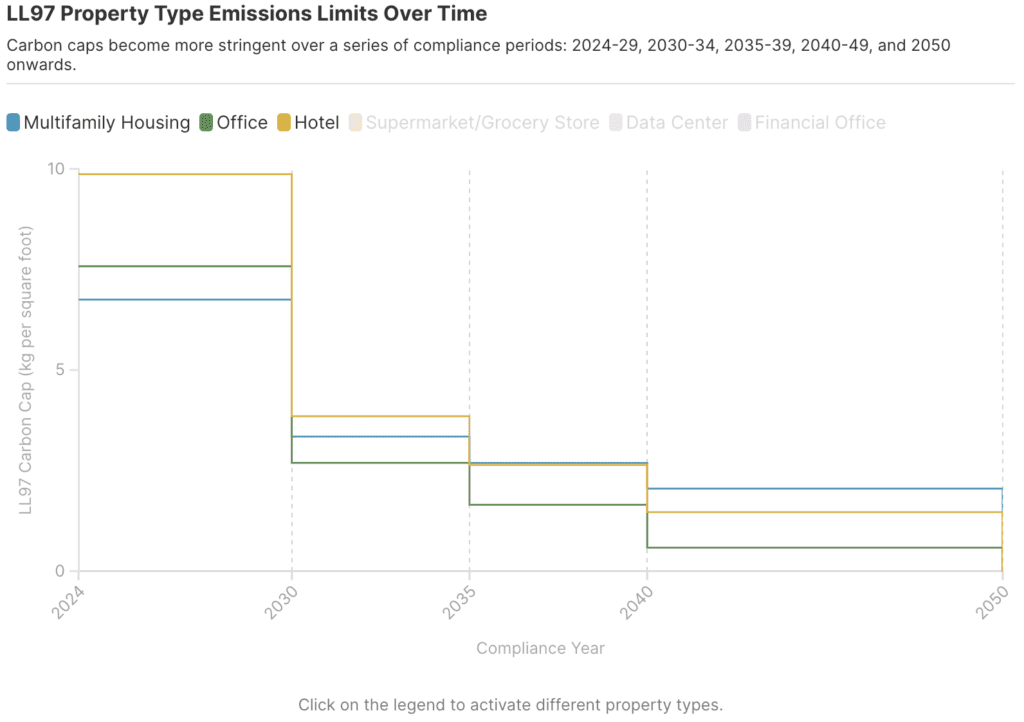
Local Law 97 places emissions limits on individual buildings that are measured in carbon emissions per square foot. Each building’s carbon limit depends on its size, property type and compliance year.
The law assigns emissions limits for 60 different property types from Energy Star’s Portfolio Manager that reflect the wide variation in energy use among buildings. Those limits ratchet down over five compliance periods, reducing the amount of carbon each building can emit over time. Explore the law’s carbon caps for some of the key property types below.
Buildings emit carbon when they use energy
A building’s carbon footprint comes from its total energy use across a variety of fuel types—like electricity, natural gas or fuel oil. The law assigns a “carbon coefficient” to specify the carbon content for each fuel type. A building’s annual emissions are determined by combining total energy use for each fuel type multiplied by its corresponding carbon coefficient.
The carbon from electricity used by buildings will go down over time as the grid gets cleaner. Local Law 97’s electricity carbon coefficient for the 2030 compliance period is about 50% cleaner than the one assigned for 2024, and aligns with New York State’s ambitious mandates for renewable energy deployment. As this happens, electrifying building systems that traditionally use fossil fuels—like heat and hot water—will be key for lowering carbon.
There are many ways for building owners to comply
Owners of buildings that must meet the law’s annual carbon limits can take a number of actions to comply, including:
- Reducing carbon directly through energy efficiency and switching to lower-carbon fuels;
- Installing heat pumps to utilize the law’s beneficial electrification credit, which rewards buildings that replace fossil fuel heating, cooling and hot water systems with highly efficient electric equipment;
- Purchasing certificates through the law’s new Affordable Housing Reinvestment Fund, which helps pay for electrification projects in designated affordable housing;
- Using credits from eligible renewable energy generation (RECs) to offset electricity emissions; and
- Installing solar or battery storage onsite to deduct from their total emissions.
Certain types of affordable and income-restricted housing have delayed or altered requirements. And some covered buildings—like houses of worship and buildings with more than 35 percent rent-regulated units—fall under the law’s definition for “Article 321 buildings.” Those buildings must perform a prescriptive checklist of low-cost energy upgrades rather than meeting the law’s carbon caps.
Owners can check DOB’s LL97 covered buildings list to determine which compliance path they must follow. For more details, see the Article 320 Info Guide and Article 321 Filing Guide.
Many buildings will have to take action before 2030
LL97 limits for 2024-2029 are currently in effect—while official 2024 compliance information from the NYC Department of Buildings is expected to be released later this year, we can estimate compliance status using energy benchmarking data. Based on 2024 energy performance data, about 9 percent of properties exceed their 2024 GHG cap, a significant improvement from just a few years ago.
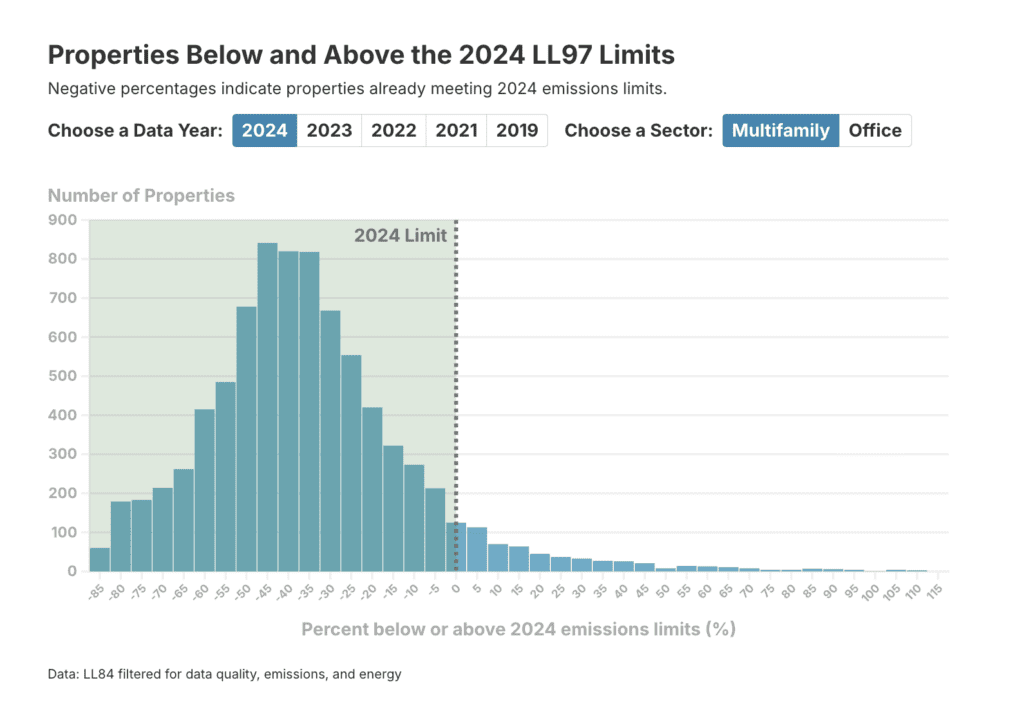
However, about 57 percent of properties currently emit more GHG than their 2030 cap, meaning significant improvements across the city will be necessary to meet the next compliance period.
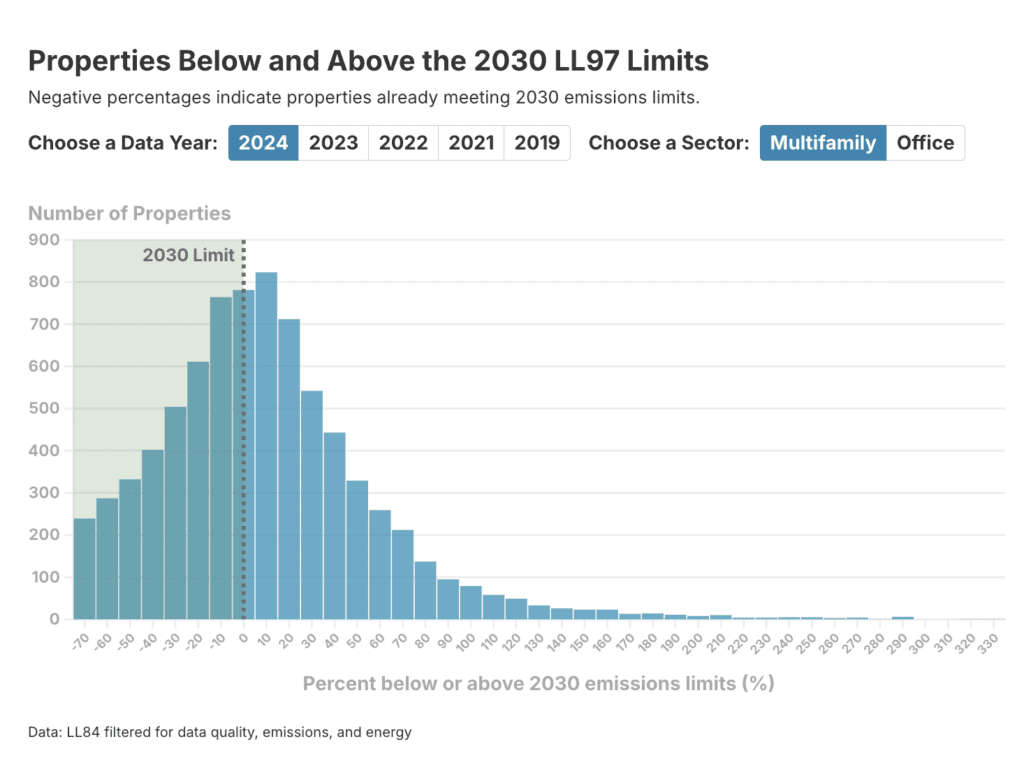
To learn more about these properties and their progress, explore our Local Law 97 progress page and NYC Building Data Hub.
Latest updates
September 2026
- On September 24, City Council passed legislation to extend and update the J-51 R property tax abatement for eligible building improvements, including upgrades to comply with LL97.
- Urban Green hosted a webinar with DOB’s Laura Popa to unpack how buildings met LL97 in Year 1. Check out Urban Green’s new analysis with key takeaways from the first year of LL97 reports.
August 2026
- All Year Two LL97 compliance reports are due by August 29.
April 2026
- Urban Green is excited to be a part of the newly revamped NYC Accelerator team with Willdan and seven other local organizations, providing one-on-one guidance to owners navigating LL97 and other building sustainability laws. Visit and request assistance from the NYC Accelerator here.
February 2026
- LL97 Compliance reports reflecting 2025 building emissions are due June 30. Covered building owners can request an extension to August 29 if requested to DOB in writing prior to the June 30 deadline.
December 2025
- All LL97 compliance reports reflecting 2024 building emissions are due December 31st, with no exceptions.

Related press

Download the Local Law 97 summary
Get up to speed on NYC’s Building Emissions Law.