New York State’s current grid can reliably support greater heat pump installations
Original publication by Urban Green Council • December 17, 2025
Highlights
- There is a 42 percent difference between NYC’s summer and winter power demand which leaves plenty of headroom for all-electric new buildings and retrofits
- Likewise across all of New York State, there is 33 percent headroom between summer and winter demand to support electrification and heat pump adoption
Seasonal trends in citywide power demand indicate that New York City’s grid has ample capacity to support heat pump installations. Currently, NYC’s peak demand occurs in the summer, when cooling is needed most, and the grid’s capacity has consistently grown to match that need. For instance, power demand data reveals that NYC’s summer peak demand remains 42 percent higher than in winter (Figure 1), consistent with what we found in our 2021 Grid Ready research report. This leaves plenty of headroom for meeting the power demand of heat pumps in the winter months. On top of that, power equipment can handle more load at colder temperatures, leaving thousands of megawatts of spare capacity across the system.
Figure 1
How about the rest of New York State?
The statewide story is very similar to what we see in NYC with 33 percent headroom, on average, for electrification. In 2024, Synapse Energy Economics analyzed the electric grid’s capacity to add additional load from building electrification across each region of New York State. This study found that existing capacity allows for “29% to 47% of all residential heating equipment to be heat pumps over the next 9 to 16 years, provided that the new loads are strategically distributed to optimize the use of the available headroom.”
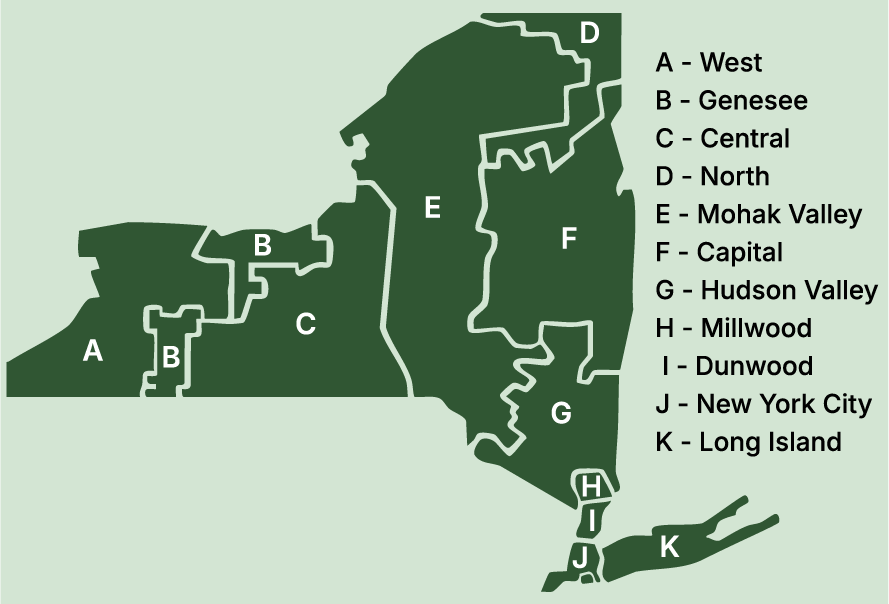
We recreated part of this analysis with the latest data from NYISO (New York Independent System Operator) – the organization responsible for operating and maintaining New York’s electric grid. Our analysis is broken down by NYISO grid load zone (Figure 2), and it confirms the key result from Synapse’s study regarding ample room on the current grid to accommodate heat pump demand.1NYISO load zones D and E currently have higher peak demand in winter than summer. This is primarily due to the presence of large industrial power users and a high share of homes that already use electricity for heating. Neither of these factors preclude heat pump adoption since many large industrial facilities are directly connected to transmission-level power (not the poles and wires homes get power from) and homes that are already using electricity for heat (likely old electric resistance systems) will see their peak demand drop by switching to a heat pump system.
Figure 2
NYISO grid load zones
New York’s regional power supply can be quantified by NYISO zone, but the poles and wires supplying power to homes are managed by local utilities
This interactive data hub is made possible with generous support from Carrier

More data stories