
Published September 30, 2026

Thank you to our lead sponsor, Carrier!
How do you move from a feasibility study to a fully financed retrofit?
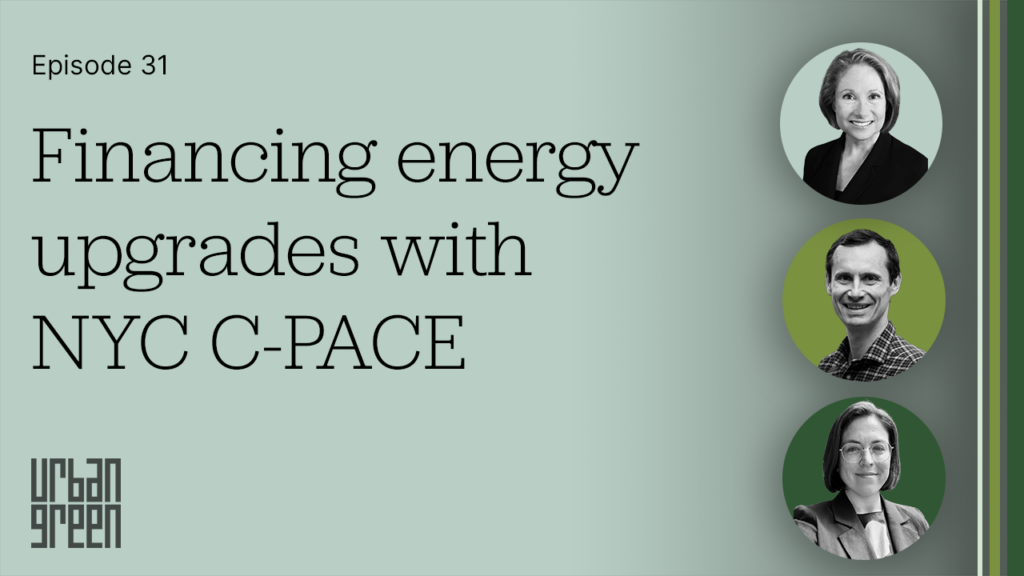
In this episode of Building Tomorrow, we trace one co-op’s journey from energy audit to retrofit project financing with Counterpointe’s Michele Pitale and Co-op President Pierre Castillon. Tune in to hear about the city’s Commercial Property Assessed Clean Energy (C-PACE) program and the benefits of securing a C-PACE loan over a traditional mortgage.
Our speakers will cover how to use C-PACE to finance carbon-reduction projects and meet Local Law 97 standards. Listen to the episode on Spotify or Apple Podcasts.
Speakers
Speakers
Michele Pitale
Manager Director, CounterpointeSRE
Michele Pitale, M.D. is a Managing Director and heads principal transactions and retrofit commercial PACE transactions. She leads Counterpointe’s team focused on commercial PACE financing with a focus on new construction development, transitional and rehab investments. Dr. Pitale provides an expertise in deep energy retrofits and a passion for advancing projects with community benefits that provide accretive economics for owners. She serves as liaison to the Department of Energy Better Buildings and the National Academy of Medicine as part of its Climate Collaborative.
Prior to focusing on sustainable energy finance, Dr. Pitale practiced medicine as an Assistant Professor of Surgery and Otolaryngology at Albert Einstein College of Medicine in New York and as a surgeon at the National Institutes of Health (NIH) in the Laboratory of Clinical Investigation, NIAID in Bethesda, MD and has authored surgical chapters in textbooks and a number of peer-reviewed research articles.. Dr. Pitale earned a BS in chemistry from Juniata College and holds an M.D. from Temple University in Pennsylvania.
Pierre Castillon
Coop President and Technology Risk Oversight Director
Pierre has served as Board President for his co-op building at 304 West 89th street since 2023 and has lived in the building as a shareholder and board member since 2019. In his role as board president, Pierre helped to spearhead the assessment and scoping of his building’s heating and domestic hot water electrification retrofit. In his daily life, Pierre works as a Technology Risk Oversight Director in the banking industry.
Danielle Donnelly
Associate Director, Programs and Engagement
Danielle is responsible for programming, engagement, and public programs. She previously worked at the Community Preservation Corporation where she managed their Sustainability Platform providing technical assistance to borrowers and lenders and produced educational resources aimed at furthering adoption of high-performance building standards and electrification. She also managed CPC’s administration of the Homes and Community Renewal (HCR) Climate Friendly Homes Fund; a $250M grant program dedicated to electrifying existing multifamily affordable housing and buildings in NYSERDA Disadvantaged Communities. She holds a B.A. in Political Science and English from The University of Connecticut.
Transcript
Note: This transcript is auto-generated.
Danielle Donnelly (00:01)
Hi everybody and welcome to Urban Green’s podcast Building Tomorrow, where we have conversations with climate solvers. Every day we meet people who make a big difference in the built environment and are moving us closer to a low-carbon future. And we want you to hear their stories. Before we begin today’s episode, I’d like to thank Carrier, our podcast sponsor. My name is Danielle Donnelly, Associate Director of Programs and Engagement at Urban Green. Today I’m thrilled to welcome Michelle Pital to the podcast. Michelle is a managing director at CounterPoint SRE.
Where she heads principal transactions and retrofit commercial pace transactions. On this episode, we’re also speaking with Pierre Castillon. Pierre is the president of his co-op board and spearheaded the capital planning, energy assessment, and project scoping that led to his building’s heating electrification retrofit. So Pierre and Michelle, we’re glad to have you here.
Pierre Castillon (00:49)
Time here.
Michelle Pitale (00:49)
Thank you very much.
Danielle Donnelly (00:52)
So, Michelle, I wanna start with you. Can you tell us a little bit about your role and more about Counterpoint SRE?
Michelle Pitale (01:00)
So counterpoint sustainable real estate started really back in two thousand ten to twelve when states first started enabling legislation to allow property owners to take advantage of financing through the property taxes, financing energy efficiency improvements.
Primarily in the early days it was to finance s solar panel installations on buildings and now it has evolved after fifteen years it’s evolved into financing all kinds of upgrades to commercial real estate. so I run the CPACE group. we finance new construction, energy efficiency upgrades and new construction. We finance energy projects, we do renovations.
such as Pierre’s project, which was an electrification of a building in New York City.
Danielle Donnelly (01:59)
For those who are not plugged into the clean energy financing space, what is CPAC? When we talk about CPACE, what are we talking about?
Michelle Pitale (02:08)
It’s a P3 public-private partnership. We are working directly with the the taxing authority to increase property taxes for a common good. So if New York City decides that they need to do some stormwater work and they hit everyone with a an assessment on their property tax bill in order to do some of the stormwater work to stop flooding, they will
You get an increase in your property taxes. This is the same type of mechanism. the it is a common good, public benefit to decrease the demand for electricity. So we will work with the Department of Finance and the program administrator for the city to provide the financing for these upgrades to private commercial buildings.
Danielle Donnelly (03:03)
When we’re talking about commercial property assessed clean energy, what are some of the best cases or applications for these products?
Michelle Pitale (03:12)
So the the best application, PACE is a very flexible financing tool, and it r it it has shown itself in in these in these early days as being very flexible to what is needed in the commercial real estate market. So in I alluded in the early days, we did a lot of financing of solar installations, and that was in the beginning of utility rate escalations that were going up into 20 cents per kilowatt hour. And
Higher, especially out in California and Massachusetts. So that remains a core business, except that it has spread. And so now we have financed geothermal installations, all kinds of renewable projects. And this is financing that you do not need to pay off your mortgage. It is an additional source of financing targeted just for these types of projects.
During COVID, commercial real estate owners were delivering properties that had maturing construction loans, and they had no revenues for the pr the projects. And that’s when we started financing a lot of retroactive financing of for completed work. And in most places, New York City included, you can finance work up to three years after it has been completed. And so we were
Paying off a lot of maturing construction loans. An office building was empty and they had done a large elevator modernization project. They were recapping that type of project in order to help put some revenues in the building during COVID. That has since exploded and retroactive financing of completed work remains a mainstay and probably the largest business that we do.
After COVID, with the raise in interest rates from the Fed, the momentum has switched and a lot of our business right now is new construction. There is a lot of stretch codes across the nation that are really pushing for electrification. That coupled with the rising costs of equipment and the rising costs of construction in a high interest rate environment has shown that low cost capital through the property taxes.
Is bringing down the blended rate in new construction so that projects can move forward. So there we are financing a a lot of multifamily new construction in the drive to provide affordable housing. I have 10 projects closing in the next couple weeks across the nation, mostly for multifamily new construction, where the
Construction loan is a lot more expensive than the pace in today’s interest rate environment. And this blended rate is allowing a project to go forward.
Danielle Donnelly (06:18)
It’s so interesting as markets change and the interest rate environment changes that pace becomes a a better tool for certain things and to see that evolution affect multifamily in this way.
Michelle Pitale (06:29)
And I’m seeing I’m seeing the next wave come in. So we probab we have the beginning of our office to multifamily conversions coming in. And you know, again, it’s a response to the current markets. And it again, it’s I’m viewing it somewhat like new construction because these are large gut renovations, but they’re very satisfying projects, mostly because we’re dealing with the embodied carbon.
issue and we’re adapting buildings that really are no longer they’re vacant. and so we have a lot of office to multi or office to hotel projects probably coming in the spring.
Danielle Donnelly (07:12)
Really fascinating. And it’s also interesting to see how the application changes across jurisdictions where the rules around pace and what you can consider clean energy under PACE change. but I know in New York that definition is fairly broad.
Michelle Pitale (07:27)
It it is, and they were on the forefront of embodied carbon. it the Colorado legislature specifically enabled it, and that New York City just took off and were the first to publish actual rules once Rocky Mountain Institute published some some type of guidelines. so embodied carbon is the new thing for PACE and it is allowing us to finance the purchase price of some of these buildings.
Which is really new and exciting. It’s it’s exciting because we’re doing a lot of historical properties right now that are being adapted to new use.
Danielle Donnelly (08:06)
So it’s great to see all of the the applications for pace and how that’s evolved over time. Where does it not work as well?
Michelle Pitale (08:14)
So if you have a great banker and you have a low mortgage rate, then PACE will most likely be a higher interest rate than than that. So there are some people on this on that are watching this that have a co-op and they can probably go get a mortgage, a co-op loan that would be a little bit of a lower interest rate than the PACE.
PACE does not work well for condominium buildings. Those are single-family residential properties. New York City just expanded their guidelines to allow those condominium buildings to be eligible for PACE, but the exact mechanism for how the how the lien is placed and enforcement and collection.
is still yet really to be worked through because we’re working with a condo association rather than the individual unit owners. So I I that is a high priority item to to work through. But right now it just it’s still waiting. I think the other place the PACE does not work well is for a building that is in that is has a mortgage that’s been securitized and is in CMBS. It yes we need lender consent.
And it can be difficult to obtain lender consent from the administrative agent if the consent has not been baked into the original loan docs. whoever the servicer is does not know if they have they can get they can give consent or not unless the original docs have it baked in, which is becoming more and more frequent that if someone who is
financing a mortgage now basing consent for PACE into their loan docs just to keep the opportunity available in the future.
Danielle Donnelly (10:12)
So that was an incredible segue to my next question, which was about consent and seniority and lenders not being amenable to PACE. because of this, we hear that PACE is difficult or expensive or weird to navigate. What has your experience been so far where mortgages haven’t written in that explicit consent? and working with commercial multifamily properties?
Michelle Pitale (10:36)
So it is it is really a weird thing to think about a private person asking the government to raise their property taxes to finance upgrades. And the number one hurdle to getting mortgage lender consent is convincing the mortgage holder that this is a property tax and has all the attributes of that, such that
They you can always cure property taxes if they’re delinquent. It doesn’t if the owner doesn’t make the property tax payment and it becomes delinquent, it doesn’t accelerate the full amount that it’s all available, it’s all becomes due like a debt product would. there whenever it is new, such as it is relatively new in New York City, there’s an educational process that needs to happen.
In some of the states that launched that have over 10 years of pace, we actually find mortgage lenders reaching out to us. There are a lot of benefits to having a pace on a property and giving consent over a mes lender or preferred equity because there are no financial covenants with the pace. If something goes wrong or if there’s problems, the pace doesn’t have a seat at the table in negotiations, which
In this time when a lot of commercial real estate is struggling, the mortgage lenders are seeing that as a as a real advantage to having f financing through PACE rather than through a mezzanine or a second mortgage.
Danielle Donnelly (12:21)
So when we’re talking about seniority and PACE, PACE traditionally takes first position in the order of debt on a building. And that’s why lenders often struggle with the concept of becoming subordinate to another piece of debt. But what you’ve described is there is less risk in this product, even if it is more senior than the rest of the mortgage or other
Michelle Pitale (12:43)
So
that that’s the whole that’s the misunderstanding and and we kind of contributed to that. There is a graphic out there that we did back in maybe 17 that shows pace on the top of a building as top of the cap stack that has become somewhat iconic for the industry. pace does not prime the mortgage. It is does not have senior priority. Only one del only a delinquent.
property tax payment would prime the mortgage. So I I think once the mortgage lenders understand that, that it’s not the full amount of the pace that primes them, you can sell a building, you can refinance a building and the pace is is not mandated to be paid off. So it is in some ways friendlier than a ground lease that has a lot more recourse or a lot more
enforcements that can go over. We’re getting really deep in the weeds here, Danielle.
Danielle Donnelly (13:47)
It’s easy though. I want everyone to have kind of a broader picture of what this product means for their build.
Michelle Pitale (13:53)
This is pr this is pace two one at this point that we’re getting into the enforcement mechanism of pace being more simple than a a ground lease. ’cause it’s it is a delayed foreclosure process. Pace for property tax foreclosures and enforcements are very homeowner friendly. So it is definitely slower and more homeowner friendly. Soon we’re getting in the weeds here.
Danielle Donnelly (14:18)
Yeah.
And I want to bring it back to multifamily buildings and particularly co-ops. What are some important things for multifamily owners and co-op boards to keep in mind as they explore pace?
Michelle Pitale (14:31)
So number one is to bring the pace provider, capital provider, in early. There are I I assume that the goal is to finance the whole project and to maximize net proceeds and to decrease the operating cost of the building, more utility savings as much as possible. We are uniquely situated as commercial real estate professionals as well as
engineering and equipment finance professionals to really straddle the intersection of commercial real estate and energy efficiency to guide a project to optimization.
Danielle Donnelly (15:11)
So there’s a greater understanding of the sustainability and energy efficiency goals, maybe more than another lender. And so bringing the the pace lender in earlier is a benefit.
Michelle Pitale (15:21)
And it’s so we talk engineering and we talk finance. so I think sustainable finance is really an evolving new field and it is not a morg it’s not a debt perspective and it’s not what your benchmark engineering, the the person who’s scoping the project. We we really straddle between the two.
And our interests are aligned with the co-op board or the owner of the property to decrease operating expenses for the building without putting too much burden for the increasing the property taxes. so we can we can straddle that line and work with the owners to help. So bringing bringing the pace capital provider in early, I think is important.
Danielle Donnelly (16:13)
So, Pierre, we’ve touched on consent, we’ve touched on early board buy-in and bringing the lender in as early as possible as the two kind of top priorities for making pace work in multifamily buildings. I wanna start with how you socialize the idea of using CPACE within your building and some of the reactions from the board. So how did you get your board on board?
Pierre Castillon (16:34)
Yeah, absolutely. So I do 100% agree with Michelle. We need to start early. for us, it was a very long process. started honestly back in 2021 when we were contacted by New York City Accelerator who mentioned pace was coming up for New York City. at the time, the rates didn’t make the product very interesting, but as Michelle mentioned earlier, the changes in rate actually and also the consent.
from the from the lender was kind of the key and the longest step for us to to obtain. we went through a whole history of what can we do, how can we finance this project? this was in long time making we had to change our old oil four boiler which was end of life. and there’s a lot of options to refinance, you know, there was space.
You can add a second mortgage. There was a couple of options that we tried to explore. But with the changing environment in terms of the rates, PACE really became the only viable and attractive option for us. the other option was to refinance our entire underlying mortgage at a much, much higher rate. We were able to secure a 2.9% rate. so refinancing
the entire mortgage plus taking on the additional money was you know Michelle talked about the blended rates and I think that that’s what really drive us to to the pace loan.
Danielle Donnelly (18:13)
You talk about this project was a long time coming and that runway gave you a lot of opportunity to explore financing pathways. I wonder if you could tell us a little bit about when you were considering the cost of a gas conversion from your oil fired boiler to potentially the electrification conversion pathway, what were the major factors that pushed you toward electrification?
Pierre Castillon (18:38)
Yes, absolutely. So like I said, this started a long time ago, but it was end of life. Even before I joined the building in twenty nineteen and and became president in twenty twenty three. we’ve been talking about replacing it. we started with an engineering study on the different path that we can take. Gas conversion, electrification. And we had in mind local ninety seven that we know we need to reduce our carbon footprint. so that was one of the driver.
we needed some expertise, engineering expertise to understand how much carbon we’re emitting, how much gas we’ll emit versus electricity, and the cost of that, including the incentives. so we obtained a report from the engineering company, and there was like three or four paths, like continuing staying with oil, even changing to oil too, we were all four at the time. going to gas, or there was two different electrification options. And
Of course, from electrification from a carbon footprint standpoint, the electrification was the one that was that made the most sense. we were actually pretty shocked, actually surprised I would say, that the cost of this conversion, and honestly thanks to mostly the incentives from Connecticut Nacerta, made the project in our particular situation pr pretty much equivalent in terms of cost between gas conversion.
or electrification conversion. There’s a couple of caveats to that, of course, in every project, but ultimately when we had to decide, we were thinking about the building, you know, and the future of the building and the value of the building for the shareholders. So even though ultimately the project cost is slightly higher on electrification, it provides a path for the future. You buy a boiler for 30 years usually, or the life is 20, 30 years at least. So
Either you spend the money and you pay the the fine later, or you actually move forward and elect and do the electrification and provide a lot of other benefits to the building. Now everyone is electrified, they have kind of central AC and heating. They can’t control their system independently. I’m not gonna go through the whole list. It’s quieter. There’s a whole list of benefits of going electric and with a heat pump for both domestic hot water as well as the heating and cooling in the apartments. So that’s
that really what drives and you know how we were able to sell to the board and the shareholders the product of elect electrification.
Danielle Donnelly (21:12)
I think it’s on one hand, there’s so many benefits to going to these unitized systems that are much more efficient, that you have more control in your apartment. but people are used to what they’re used to and these kind of like old centralized systems with the radiator that gets hot and you know, maybe you do crack your window for a little bit more, you know, temperature control. so was there much convincing you had to do on the board side and with the shareholders?
To get a yes on the unitized heat pump systems.
Pierre Castillon (21:46)
that’s a tough question. indeed, people change is hard. And one of the main challenges of this project is indeed that you have to go any apartment and there’s some some construction in everyone’s apartment. really what we try to do is sell them, I would say, on on two things the board and the shareholders, like the comfort, you know, but also the they’re saving space. We’re removing irradiators, you know. New York, everyone has small apartments, so we’re removing the irradiator from the floor. You’re getting all that space so you can put a furniture now.
That that really helped. also so that was one piece, you know, the comfort and all the benefits of of of electrification, including the fine later on and the increased value of the building when they resell. Like if we stay to gas and everyone else is moving to electrification, we’re still behind and the property value just goes down. So that was one of the the other component was actually the the finance part of it. And because we had a bit of a money on the side that for the estimated project that we had on
on the gas and ultimately we needed more funding, but with pace, we were able to end the incentive, we were able to make it affordable for the building, and not raising the maintenance significantly to to pay for to pay for that project.
Danielle Donnelly (23:02)
That’s great to hear because I think people think heat pumps and think it’s gonna be so expensive, and especially in a co-op building, that your annual maintenance fees are gonna go up significantly. And that wasn’t the case for you. and that was sort of my next question. So when you move from a centralized heating system to these unitized systems, the utility burden changes from the the building kind of centrally holding those costs to the individuals.
Did anything else change financially within the building and how did you navigate that new unitized system?
Pierre Castillon (23:36)
So yeah, the one of the the great benefit of electrification is the fact that now everyone controls their own heat and cooling system. Cooling was always the case, but from heating standpoint everyone controls them. So while people might have been away for a weekend, a week and their apartment was heated like on C seventy eight, you know, sometimes it was like this the summer you would want to put an AC on. this is how hot it was. to now like lowering to a much h lower temperature and not using that much electricity.
we have people that don’t necessarily live all year long in their building. They don’t need to pay utilities for everyone, for everyone else so when they’re not using. So that’s also people are now understand better what it is, you know, to hit and cool your apartment versus it is a big change and I think we’ll continue to do some education when the systems are up and running. but that’s that is one of the the big changes that we we had to sell when we when going for electrification.
Danielle Donnelly (24:35)
And I wanna bring Michelle back into the conversation and talk about what sort of education was needed so that everyone understood the new technologies and the tax liabilities that were coming when you pursued the CPACE product to do this work.
Michelle Pitale (24:51)
Here took the the brunt of it.
Pierre Castillon (24:56)
I think from us, it is a complex product. and thank you to Michelle and her team. They were, you know, here to help us try to understand. it was a learning for us, and I think hopefully it’s one-time learning. But a lot of the learning and other education also had to be done with the lender. I think the what slowed down the process the most is not us. We were ready to move forward, we’re ready to but the limitation that we had.
it was really related to the the lender and the consent, to understand them, for them to understand and provide their consent.
Michelle Pitale (25:36)
Yeah, it if if you’re dealing with a big national bank for your mortgage lender, then they have heard of PACE and they it has been to their boards and they’ve made decisions and they know how it works. If you’re dealing with a regional bank that’s giving that’s providing your your mortgage, it this will be a new product for them. They have heard of it at this point, but they have not grappled with it and haven’t
Again, it goes back to they think it’s debt that it primes them and they just have to keep bringing them back. This is through the property taxes. but that’s a long process for for banks. You had a bank, private debt fund or someone else might be a less they might have less committees to get through.
Danielle Donnelly (26:25)
So on the board side, you have to socialize the issue, you have to do the electrification study or assessment so that you know your pathways and then you bring in the lender and the lender can do a lot of that education for the rest of the shareholders, but also engage with your mortgage lender and make sure that you they understand and that you can follow this pathway without a lot of resistance. So I think you guys worked as a great team, clearly, because this project is moving forward and
I we’re really excited to see the results. I’m wondering, Pierre, on the technology side, what sort of education or resources did you provide to all of the shareholders so they understood how to operate the systems, you know, what work would be done in their apartments, how this would go.
Pierre Castillon (27:11)
Yeah, so that’s something that we’re still working on. The education part of the systems are not on. But we had several meetings and presentation and communication that we send regularly on the update of project and how heat pumps are working. And as we’re heading to the heating season and our system are gonna be turned on, we’re definitely gonna, you know, send communication. We have a great super who’s gonna help us, you know, with some of the people that might struggle a little more, setting up the systems, making sure that they understand how to
maybe step down a little bit if they go on for a while, not overheating the apartment. it’s it’s gonna be it’s gonna take a long time, I’m sure, and we’re gonna have to have a lot of communication with the board and with the shareholders. So the financing pace is one part. We needed to figure out how much saving we’re making and we know there was a part that needed to be financed and included in the maintenance, but pretty small. But the saving portion, like we’re not paying for oil anymore.
We still have to pay for heating and cooling, heating mostly of the common areas and the domestic hot water as a co-op. but how much is that compared to the total cost of of of oil? We’re not sure. So the way we decided to, as a board, structure it is we had a small increase of maintenance, kind of the annual increase maintenance pretty much. And then we did an assessment for for a year, which is the estimated of the savings. And after running those heat pump.
internally for us, for the again the the the heating system i in the common areas and the domestic hot water, we’ll see if actually we’re having more savings than anticipating or less savings than anticipating to be able to adjust the maintenance accordingly the following year or even in tri year depending.
Danielle Donnelly (28:57)
No, that’s so helpful to understand kind of that you are doing an internal study about the actual operation of these systems and then adjusting what it will cost for for all of the shareholders as a whole to do those common areas and to provide hot water to all of the units. So I think that’s a great
Pierre Castillon (29:13)
We didn’t want to raise the maintenance to a level and then, actually we are now need we need to reduce the maintenance system. I think it’s better from a shareholder’s perspective to just have an idea. like the maintenance usually unfortunately only increased, they rarely decrease. So maybe it would have been a good surprise. But you know, from the value standpoint for the apartment, I think it’s better for if someone’s trying to sell to have lower maintenance with an assessment and and later increase the maintenance eventually to the right amount.
Danielle Donnelly (29:45)
So as we close out this conversation, I’m wondering if Michelle, you can go first and then Pierre, what’s one thing that you wish multifamily building owners or co-op boards knew when considering pace to fund local law ninety seven retrofits?
Michelle Pitale (30:01)
It’s easier than the mortgage process. Faster, easier. the documents are simple. It’s different. So you’ll have to learn what the differences are, but it is overall, there’s there’s no credit checks. right? Pierre, we didn’t ask for your financials.
Pierre Castillon (30:24)
There was a scary part at some point at the very beginning of the process when we thought that every mortgage lender of every apartment needed to get a letter of consent. I don’t know if you remember that, Michelle. Yes.
Michelle Pitale (30:36)
So that was a clarification from New York City. I’m actually glad you bring it up because it’s a big point. So lender consent is required, and we got clarification from New York City that it was just from the mortgage held by the co-op, not by each unit owner. In Los Angeles, we did a co-op seismic retrofit with NCB as the mortgage lender national for co-ops.
And we needed to get consent from every unit owner in the building. Got it. but you know, it was only I think a ten or twelve unit building, so it was a little bit easier than your building.
Pierre Castillon (31:16)
I can’t imagine going to thirty nine or thirty eight.
Danielle Donnelly (31:21)
And you’ve got co ops in New York City that are three hundred units or even larger. So I I can’t imagine that being the process and I’m glad it’s much easier to navigate.
Michelle Pitale (31:30)
was
it’s usually one loan officer, one bank so you do one for this bank, one for this bank, and just rack up. Just all of them. But it it adds a level of complexity that I was glad the New York City said was not required.
Danielle Donnelly (31:46)
And Pierre, same to you. What’s one thing you wish multifamily owners or co op boards knew when considering pace for local on ninety seven retrofits?
Pierre Castillon (31:56)
So I think it was back to the beginning, I think time. And maybe it’s based on my specific situation and the fact that we’re the first co-op, you know, in New York to to do that. But this whole tick from a technical standpoint and a financing standpoint took a long, long time. but like Michelle said, I think it was just mostly the lender consent that really took a long time. From a documentation standpoint and all that, like on a
on a C base side, you it was pretty fast and, you know, again, Michelle and team really helped on that. if I can add on one other thing that I think we didn’t touch upon quite yet, is the consent from the bank unfortunately doesn’t also come cheap. So they need to think about that. But this is something that kind of came toward toward the end of the process where we didn’t have any choice but to go back. They lowered our amount, you know, that we can borrow, all those things, you know, where
are things that you just wanna wanna think about when you are you’re doing you’re doing pace ’cause that’s it can’t be too tight. You have to create some margins.
Danielle Donnelly (33:03)
Thank you to our guests, Michelle and Pierre. I really enjoyed this conversation. All the resources from today’s episode will be linked in the description. I’d like to thank Carrier for sponsoring this podcast, and thank you to Urban Green’s members and sponsors. If you’d like to become a member, please visit UrbanGreen Council.org. Thank you for tuning in today. If you’re enjoying this podcast, please consider subscribing so you don’t miss out on any of the great conversations. See you next time.
Banking on Climate
Jamie Horton and Marianna Koval join Adam Schiabor to discuss the recent report, Banking on Climate, which dives into the role of mortgage lenders in supporting building decarbonization efforts in New York City.
C-PACE in Action: Financing clean energy projects in New York
Learn how you can use NYC’s C-PACE loan program to cover the upfront costs for your clean energy projects.