
How are NYC buildings complying with LL97?
Original publication by Urban Green Council • September 23, 2026
Highlights
- 95% of properties filed their 2024 LL97 reports
- 95% of those met their requirements – emissions limits or one-time upgrades
- Fewer than 1% used alternative compliance options
- The City continues to reach out to non-compliant properties – but a handful of owners have chosen to pay fines
Results from the inaugural year of Local Law 97 compliance and enforcement are in. Here are four things you need to know about where the law stands today and where it’s headed next. For a deeper dive, watch Urban Green’s webinar with the NYC Department of Buildings, and read the DOB’s full report here.
Nearly all building owners engaged
Ninety-five percent of properties filed their 2024 LL97 reports, a reflection of ongoing cooperation and buy-in among building owners, city government and industry stakeholders.
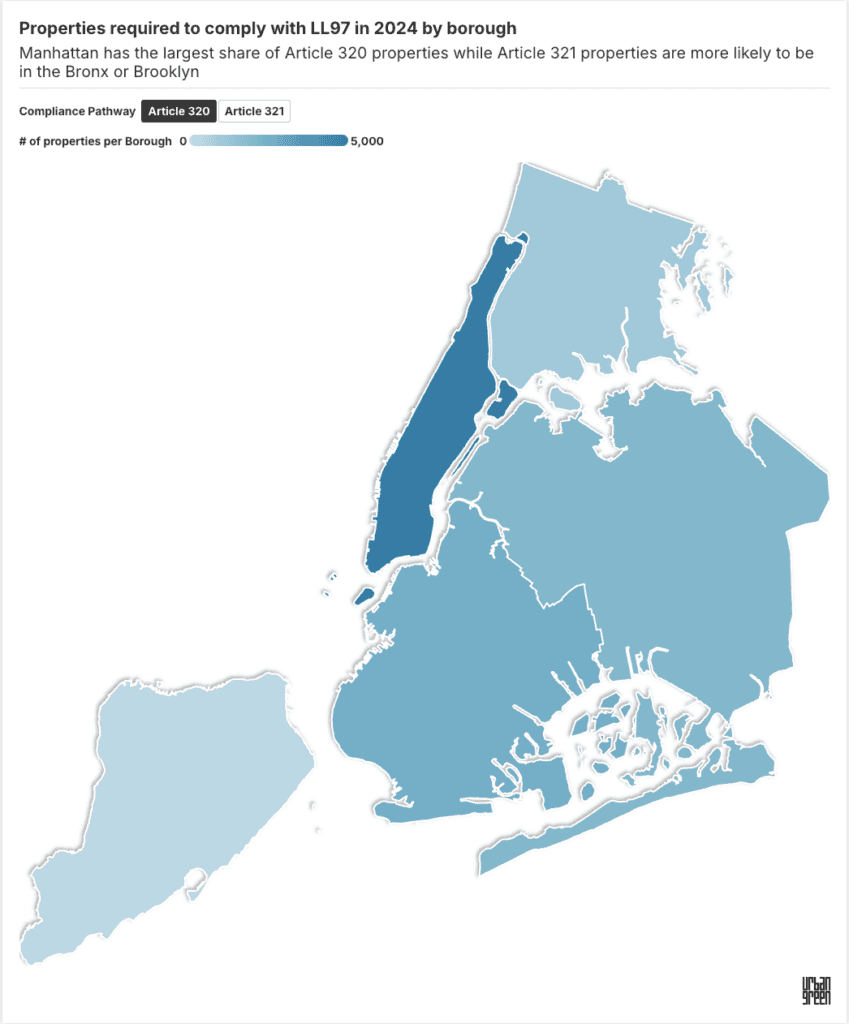
This high engagement rate spans all property types across all five boroughs, including many affordable housing buildings. The map below shows the count by borough of properties required to report in 2024. Article 320 properties must meet specific carbon limits. Article 321 properties can instead comply by completing prescriptive upgrades, an option primarily available to some affordable housing and houses of worship.
Figure 1
Most properties met their compliance requirements
Filing a report is only the first step – Local Law 97 also requires properties to meet GHG emissions limits or other requirements. And here again, about 95% of properties met their requirements.
Compliance with the law can take several forms:
- Meeting emissions limits: Keeping annual carbon emissions below the law’s limits (primarily required for Article 320 properties).
- Making one-time building upgrades: Finishing a list of prescriptive energy-saving improvements (an option for Article 321 properties).
- Using alternative compliance options: Purchasing Affordable Housing Reinvestment Fund offsets, requesting an adjustment, or applying for a good faith effort mediated resolution (more on this below).
Article 320 vs. 321
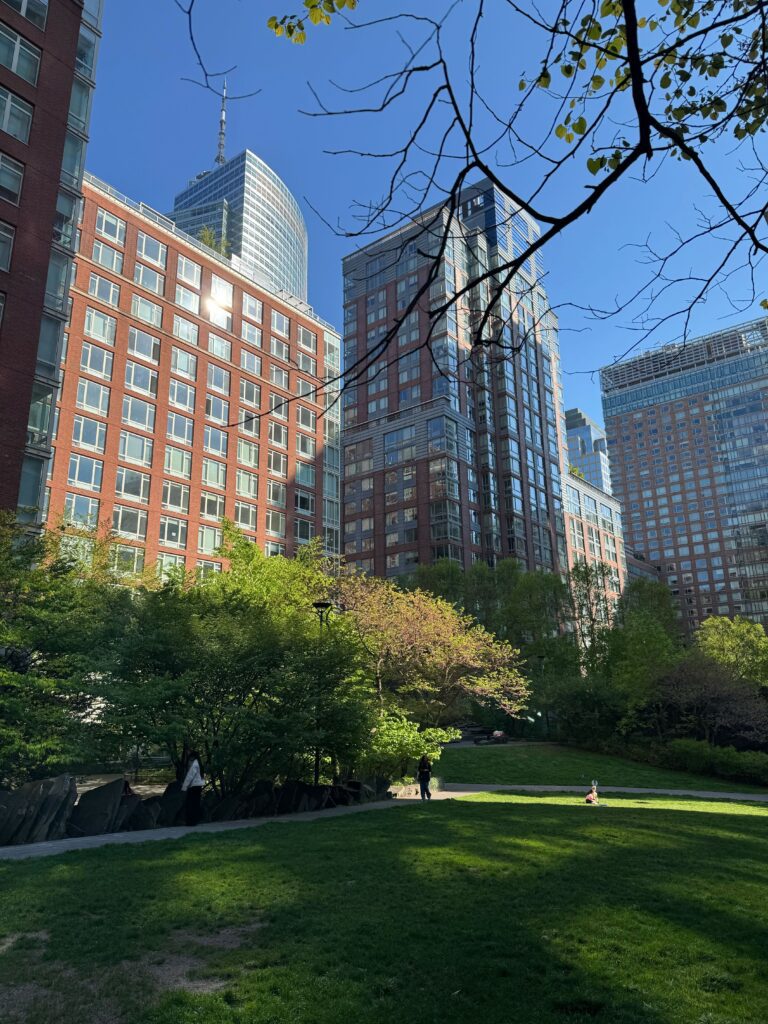
Article 320: Annual reporting on building emissions against a cap (most properties)
Article 321: One-time reporting on a checklist of upgrades or an emissions cap (some affordable housing and houses of worship)
Article 320
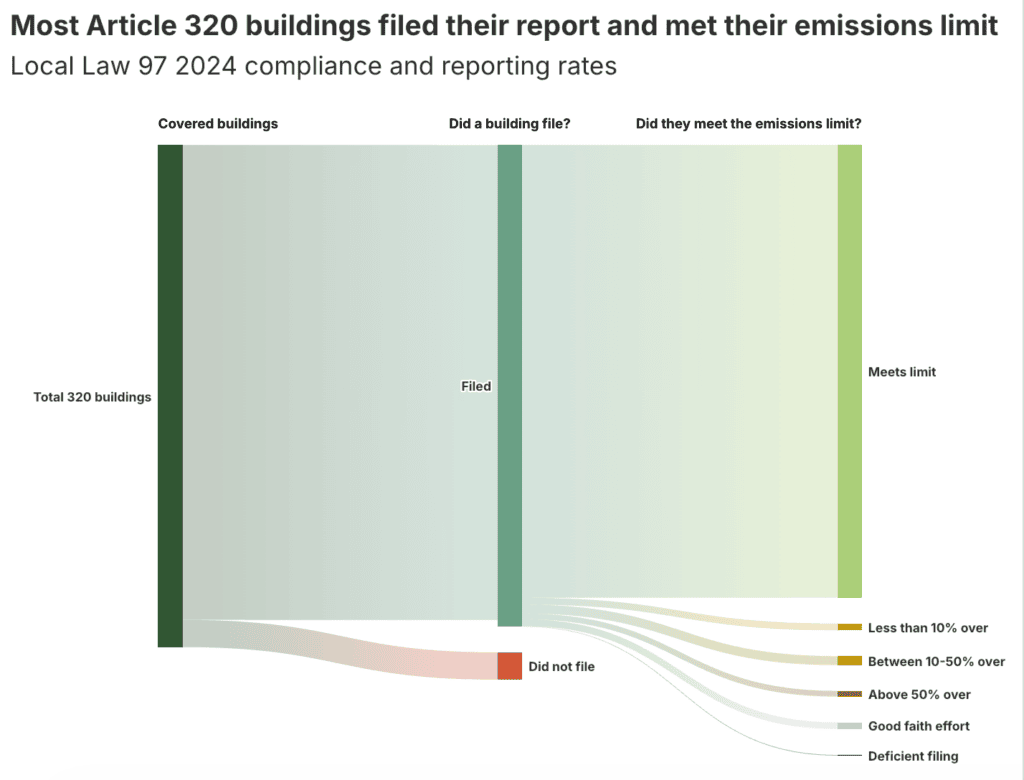
Ninety-five percent of Article 320 properties met their property-specific emissions limits in 2024 – up from an estimated 80 percent when the law passed in 2019. And the Department of Buildings audited every single Article 320 report to verify the results.
Figure 2 below shows properties that met or missed their 2024 limits, with many of those that missed being close to their limit or opting for a good faith efforts mediated resolution.
Figure 2
Article 321
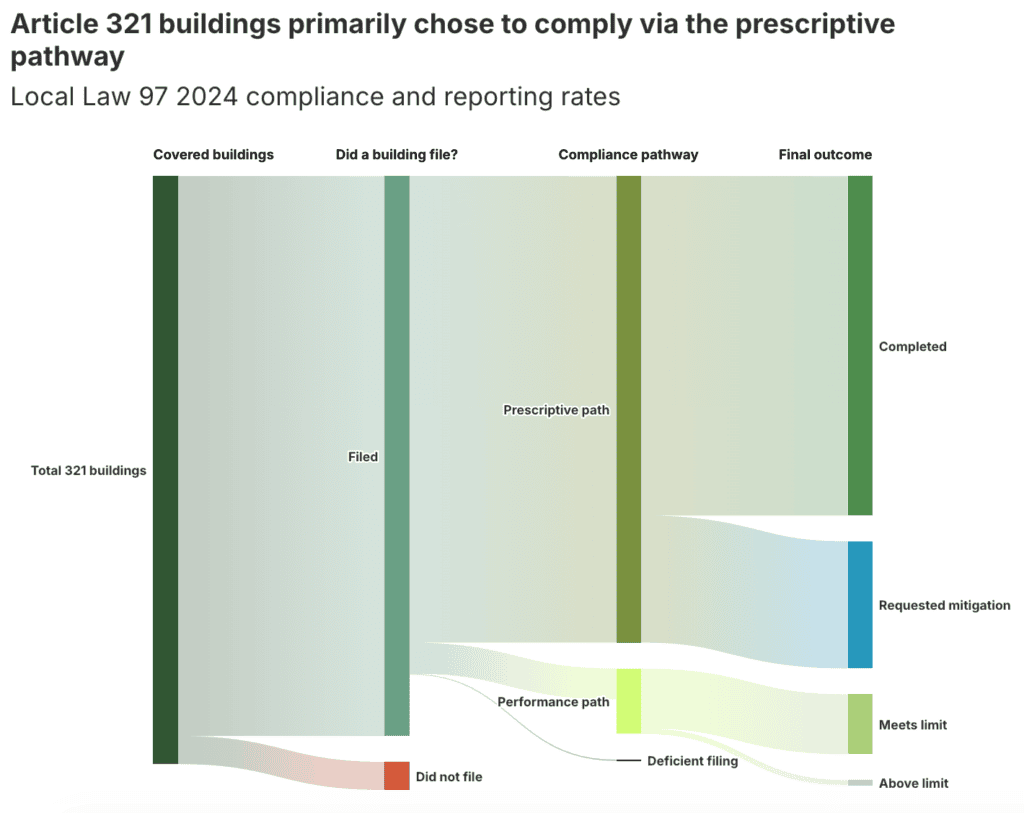
Article 321 properties could comply in different ways, so there’s no single compliance rate. But about 95 percent completed their requirements or requested mitigation from the Department of Buildings.
Figure 3 below shows that 83 percent chose the prescriptive path (prescribed energy-saving upgrades) over meeting a carbon limit. Three-fourths of these fully completed their upgrades, closing out their one-time Local Law 97 obligation. The rest requested mitigation, a process with the Department of Buildings, which grants them additional time to finish.
About 12 percent of Article 321 properties chose the performance path (meeting a carbon emissions limit), and most of these properties met their building-specific limit and completed their one-time LL97 requirement.
Figure 3
A small but meaningful number of properties used alternative compliance options
NYC’s buildings vary widely in age, use and resources, so Local Law 97 has alternative compliance options to help owners meet their limits, including carbon offsets, adjustments, deductions, and alternative calculation methodologies.
Less than one percent of properties used an alternative compliance option in 2024 – unsurprising, since most buildings were already under their limits when the law passed. The most common was purchasing carbon offsets through the Affordable Housing Reinvestment Fund, which has so far raised $1.7 million dollars for energy efficiency and electrification upgrades in affordable housing citywide. A small number also used deductions tied to solar power or early heat pump adoption.
Most properties that needed to cut emissions between 2019 and 2024 did so through efficiency upgrades that reduced fossil fuel energy consumption – a sign the law is working as intended. But we expect more properties to make use of these flexibility tools come 2030, as buildings begin to plan and implement bigger upgrades like heat pump conversions.
Enforcement has focused on compliance, not just penalties
The goal of Local Law 97 is to cut emissions and support building upgrades, not to collect fines. The Department of Buildings did extensive outreach ahead of the first filing deadline, and it worked: only five percent of properties failed to file across Article 320 and 321.
The Department also granted good faith effort mediated resolutions to properties that are working toward compliance: almost a third of properties over their emissions limits received one in 2024, giving them time to complete energy-saving retrofits.
This supportive enforcement approach continues for the remaining non-compliant properties, many of which are filing once the Department of Buildings refers them to the City’s Office of Administrative Trials and Hearings (OATH) for penalty assessment. As of mid-September, about 15 properties have paid penalties instead.
Year one shows Local Law 97 working largely as designed, with high engagement, strong compliance and enforcement paired with flexibility. Properties under Article 320 will now be submitting reports every year to monitor progress, but the real test will come as emissions limits tighten in 2030, when more buildings will need deeper retrofits to comply.
Local Law 97
NYC’s groundbreaking climate legislation sets carbon emissions caps for large buildings that began in 2024.
Latest building energy use trends
NYC's 2024 benchmarking data is here! See how building energy use is changing.