
Published June 17, 2026
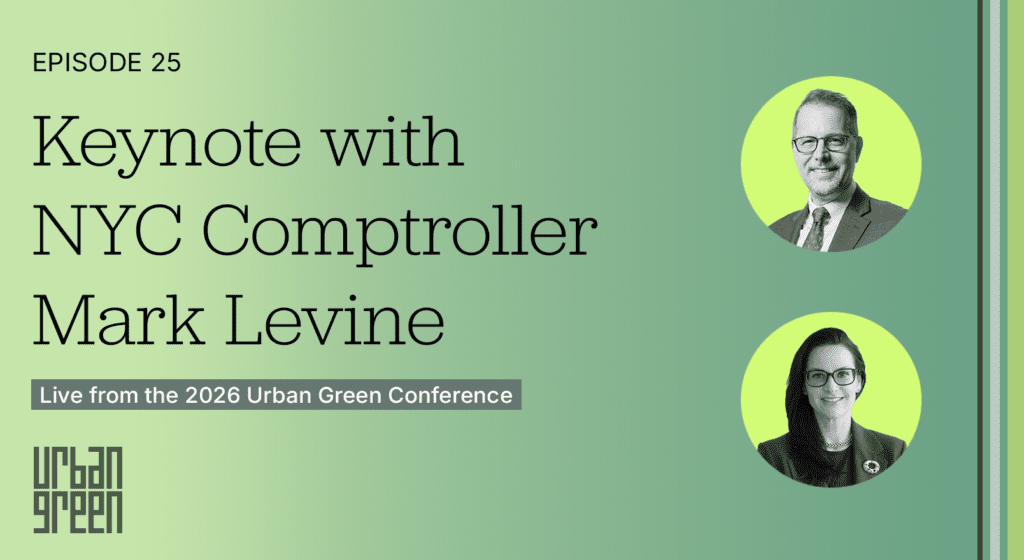
For this episode of Building Tomorrow, we’re excited to share our live conversation with New York City Comptroller Mark Levine! At our 2026 conference, the city’s comptroller joined Urban Green Board Chair Sara Kendall to discuss the relationship between the climate and the city’s economy.
You can find the full video of our conference introduction and keynote conversation on YouTube and our event recap page.

Thank you to our sponsor, Carrier!
Speakers
Mark Levine
New York City Comptroller
Mark Levine has been at the forefront of advancing more affordable, equitable, and healthy communities for nearly 25 years. He began his career as a bilingual math and science teacher in the South Bronx and went on to found Neighborhood Trust Federal Credit Union, which has since provided more than $100 million in loans to families and small businesses across Northern Manhattan and the South Bronx.
Mark served for eight years on the New York City Council, including as Chair of the Committee on Parks, Chair of the Jewish Caucus, and Chair of the Committee on Health. In the latter role, he brought a science-based, data-driven approach to helping lead New York City through the worst public health crisis in a century. During his tenure, he authored and passed landmark tenant protections, including the nation’s first Right to Counsel law, guaranteeing legal representation to tenants facing eviction who cannot afford an attorney.
Mark was elected New York City Comptroller in November 2025 and assumed office on January 1, 2026.
Sara Kendall
Group VP, SourceBlue LLC; Turner Construction – Chair, Urban Green Council Board of Directors
Sara is Group Vice President of SourceBlue LLC, where she leads the development and execution of short- and long-term strategic initiatives that strengthen the company’s position as one of the world’s leading procurement and supply chain management firms. Previously, she led Turner Construction’s New York City Interiors business. With more than 25 years of experience managing complex construction projects, she is known for her leadership, communication, and problem-solving, as well as her ability to deliver high-profile projects across the commercial, life sciences, residential, and healthcare sectors. Sara also serves as Chair of the Board of Directors for Urban Green Council.
Key takeaways
- The New York City Comptroller’s Office aims to mitigate the impact of extreme weather events and rising energy costs on the city’s economy and people. By allocating pension funds to decarbonization and resilience efforts, the Comptroller’s Office plays a critical role in creating a sustainable future for New York City.
- Fossil fuels are not a stable long-term investment because of the threat climate change poses to the city’s infrastructure and skyrocketing costs. Investments in clean energy, flood resilience, tree canopy coverage, and more are essential to protect the city from environmental crises and energy insecurity. These investments also aim to make energy more affordable.
Transcript
Note: The transcript is AI-generated and may contain some inconsistencies.
Jada Shannon (00:01.058)
Hi everyone! Welcome to Urban Greens Podcast, Building Tomorrow, where we have conversations with climate solvers. Every day we meet people who make a big difference in the built environment and are moving us closer to a low-carbon future, and we want you to hear their stories. Before we begin today’s episode, we’d like to thank Carrier, our podcast sponsor. My name is Jada Shannon, and I’m the communications coordinator at Urban Green Council.
Today, we are proud to share a live taping of the keynote conversation from our 2026 conference at NYU. At this year’s conference, New York City Comptroller Mark Levine sat down with Sara Kendall, who serves as the chair of Urban Green’s Board and is the group vice president at SourceBlue LLC of Turner Construction. In this episode, you’ll hear from our new CEO, Chris Halfnight, as he introduces himself and welcomes our speakers. Then,
You’ll hear from Comptroller Levine and Sarah Kendall about the relationship between the city’s economy and climate action. Please enjoy.
Chris Halfnight (01:08.098)
Good afternoon, everybody. I’m Chris Halfnight, the CEO of Urban Green Council. Feels pretty good. I am so honored to be stepping into this role, and I’m grateful to be here with all of you today. Welcome to NYC Next, 2026 Building Trends. There’s no doubt this is a consequential moment for New York City and for our buildings. Federal support for climate action has evaporated.
We have a new mayor, a new city council speaker, a new comptroller. Affordability and energy reliability are increasingly shaping policy discussions. And still, innovation continues to accelerate. That’s what this conference is about. And we’re going to hear from the leaders who are shaping the future of buildings in New York City and well beyond. We’re going to start with a keynote conversation with New York City Comptroller Mark Levine. We’re very honored to have him here today.
Then we’ll explore how to communicate about building decarbonization in a changing landscape, how the growing challenge of energy insecurity is affecting households, how multifamily buildings are navigating electrification, local law 97, rising cooling demand, and more. And lastly, what we’re learning from the first year of compliance of local law 97 and what’s ahead on the road to 2030.
At Urban Green, our mission is to decarbonize buildings for healthy and resilient communities. And today’s conversations are at the heart of that mission. I’m very excited for the program ahead. But first, I want to thank the organizations that made today possible. Our host sponsor is NYU. This is actually the tenth year that we’ve had our conference here at NYU, so I want to thank Cecil and NYU for having us in their house yet again.
We’re also very fortunate to have two lead conference sponsors. Our first lead sponsor is Carrier. Carrier’s been a longtime supporter of Urban Green. I want to thank them for their support for the conference today and also for many years of support for Urban Green. Thank you, Carrier.
Our second lead sponsor is NYSERDA. I want to thank NYSERDA for their sponsorship today, but also for continued leadership on building decarbonization in New York City and state. And then our reception sponsor is the US Green Building Council. So I want to thank USGBC for their longtime collaboration and support and for being our reception sponsor today. We’re looking forward to celebrating later tonight.
Now let’s get started. It’s my pleasure to welcome and introduce New York City Comptroller Mark Levine and Urban Green Board Chair Sara Kendall.
In his current role, but also previously as Manhattan Borough President, and before that, a long stint as a city council member, he’s been a leading voice on many of the issues shaping our city’s future. We are grateful for his public service and delighted to have him with us here today. And joining him in conversation is Sara Kendall, who is group vice president of Source Blue at Turner Construction. She is also, of course, Urban Green’s esteemed board chair. She brings deep expertise in the built environment and a very thoughtful perspective on the issues and challenges facing our industry. Please join me in welcoming them both to the stage.
NYC Comptroller Mark Levine (04:51.598)
Thank you.
Sara Kendall (04:53.556)
All right, thank you everyone. We’re delighted to kick us off here today to set a very broad view from the top of city government. Before we dive into the fiscal implications, the policy work, and what’s next for New York City as it relates to Local Law 97 and beyond. So thank you, Comptroller Levine, for joining us. Welcome to New York City Next.
NYC Comptroller Mark Levine (05:21.044)
This is where I say I’m honored to be here. Okay. Thank you. I’m thrilled to be here. We got a capacity crowd for green buildings. This is amazing. I think it’s a very good day, beautiful weather. We just turned on the Champlain Hudson Line yesterday, getting some renewable coming in.
One of the few rooms I can say that and get an applause. I like that. And as was previously mentioned, the Knicks are about to begin their four game sweep tonight, so love. I’m in a very good mood.
Sara Kendall (05:54.146)
Thank you. Good. We’ll we’ll make this easy for you then. Your role as the comp troler is one of the, I’ll say, least understood roles in New York City’s government, but it has one of the biggest opportunities to make an impact for the things that the folks in this room care about. So could you help us understand how your office can make progress on climate and decarbonization?
NYC Comptroller Mark Levine (06:22.102)
Sure, it’s okay. I know half of you never heard of the Comptroller’s Office. It’s all right. it is actually extremely important for the budget, the economy, and the functioning of government here and touches climate policy in many, many ways. We oversee our very large pension system. It’s anyone know how big the pensions are in New York? Anyone wanna take a guess? Anybody? A billion?
Yeah, that was pretty good. Three twenty is that pizza cora? Yes it is. Of course.
Sara Kendall (06:51.95)
Did you plant someone in our audience?
NYC Comptroller Mark Levine (06:54.67)
We’re up to 325, Pete. Don’t heckle me by the way, please. We own every single asset you can imagine. And we are deeply engaged in the work of helping to decarbonize the economy. We’re gonna talk a lot about that, but we do so much more. We oversee the issuing of the city’s debt, which is how we finance the green infrastructure that’s gonna get us to the next level in New York.
We also have audit power over every part of city government. And so all these agencies that are slow to approve projects and are putting up barriers for you and us to build what we need to build, we can bring some accountability there for sure. We approve the contracts of the city, which so many of you, I presume, have to do the work that you do. Not exclusively a green issue, but we also enforce wage law for New York City. I know many of you do prevailing wage work. Some of you occasionally sue the city, and we manage the tort claim process. So we probably interface with all of your offices, but climate is huge for us. It’s a huge priority for us, and I’m excited to talk about what that means.
Sara Kendall (08:08.854)
You mentioned the pensions and the opportunity in the city’s pension funds. Can you talk a little bit more about how you think about climate risk in those portfolios specifically? And what does it mean to be a climate-conscious investor at that scale?
NYC Comptroller Mark Levine (08:27.704)
Well, there are many ways in which climate risk is financial and economic risk for us, for our city, certainly in our pension portfolio. We believe quite firmly that
the futures in green energy from a moral perspective and also from a financial perspective, and that fossil fuels present not just moral problems but also financially, are long-term losers, and that’s reflected in some of the policies that we’ve put into place, which perhaps I’ll talk about
But also there are many other ways in which this issue impacts the finances and economy of the city. There’s all sorts of ways where New York City’s budget is impacted when we have extreme rain events or other resiliency failures that cost us more money. There’s all sorts of ways in which our failure to make progress on green energy.
is an affordability failure for the city government and for city residents. So in many, many ways there’s overlap between my charge in looking at the finances and economy and our common goal of greening New York City in the broader world.
Sara Kendall (09:37.55)
So you mentioned city residents before this role, you were very involved in housing issues across Manhattan, and you recently announced a four billion dollar commitment to finance affordable housing through the pension funds. So I’m curious, can that capital advance decarbonization at the same time? And where are the issues of affordability, housing, and climate progress coming together?
NYC Comptroller Mark Levine (10:07.626)
Okay, really proud about this housing plan. And before I dive into that, I am gonna offer a very quick big picture on New York City’s pension funds. plural. We don’t have a pension fund, we actually have five, which is an added complexity in my life. We have a fund for police officers and firefighters and teachers. We have a very large catch-all that’s probably the most well-known: New York City Employee Retirement Services, NICERS, which is many city employees, also employees of New York City training.
Transit and one more small fund. So it’s it’s it’s a complicated system. They each have their own independent governance; they have a different mix of trustees from the labor unions that represent the workers and retirees from various city government entities and leaders, of course, my office as well. And they have taken a somewhat different approach across the five funds to climate. But I’m very proud of the fact that in 2023,
Three of the funds, this very large catch-all, which I mentioned before, NICERS, our teachers, and the smaller fund known as Burr’s, they committed to a decarbonization plan by twenty forty, making us, I think, probably the most forward-looking pension system in America. I know that other if I need to address that. Is that a climate emergency? Or is that all right, I’m gonna ignore it until someone tells me otherwise?
This is very, very important to how we operate every single day. We have made some progress. We have a lot more progress to make, but at the moment, we’ve achieved a 45% reduction in carbon relative to our 2019 baseline across our publicly traded assets. We have such a diverse portfolio. It includes more than just publicly traded stocks, but for that focus we’ve made progress. We got more to go by twenty forty. In addition to getting out of fossil fuels in those funds, we also push our portfolio companies to ensure that they have plans to decarbonize, and we push our fund managers to push those portfolio companies.
And we’re also increasingly, in a very affirmative way, investing in the green technology we’re gonna need to manage this tr transition. Our housing investment, I think, is related to this to some extent, but it’s a priority for us as New Yorkers, as people who live here, the people who are worried about.
What is the worst housing affordability crisis New York City has ever faced? I’m sure this is on many of your minds. You’re building the housing. We’ve made a lot of progress in modernizing our zoning so that it is less of a barrier. We have some work to do more, but we’ve really unlocked the capacity to build a lot more housing in New York after the city of Yes, after these charter amendments that were passed last November, which make it gonna make it easier to rezone.
I think that the biggest challenge at this point is financing that housing. And there are vacant lots all over New York City that are waiting for financing. And so we wanted to help solve that. We have announced a commitment to put four billion dollars of our pension money into financing housing in New York City. Now, of course, new housing tends to be is greener, so there’s a big win there. We also have money for preservation, which is very often for environmental retrofits.
And so very often specifically for local law ninety-seven compliance as part of a preservation investment. We also have money that’s gonna go into conversion of vacant office buildings to housing, which is better than knocking down an old building and building a new one; much bigger environmental win to retrofit what you already have. So while this is mostly about solving our housing shortage, solving our housing affordability crisis, I think there’s also green benefits even in our housing work.
Sara Kendall (14:14.552)
Affordability is a major buzzword topic that often comes across the investments for climate progress. It’s not unusual to hear certain leaders say, “We can’t afford it; it’s not the right thing to do.” Can you help us find language or ideas about what you’re speaking about? The investment that we’re making in affordability, but yet still being able to make progress on climate, and that the two are not in conflict. Yes.
NYC Comptroller Mark Levine (14:50.086)
After years of progress on climate, we have really had a rough couple of years now, both in terms of policy but also the rhetorical and political landscape is tougher now than it was. For us, for us, as practitioners, as politicians, but also the pressure on many of the companies that we are pushing to decarbonize. It’s also been an added challenge. It’s really changed the dynamic relative to only a few years ago. I happen to think that we have some very, very compelling cases to make. One of which is absolutely affordability. And we’ve talked about it for housing; we talked about it for healthcare, but energy is top three if you want to pull New Yorkers. Unfortunately, the costs are going up. And what we’re doing by bringing more supply in through the Champlain Hudson Line.
Among other things gonna help affordability. I firmly believe that. Some of the infrastructure you’re installing- the beauty of green energy is you pay up front to put the solar panels in, and then the cost is very little, almost zero going forward. So an affordability win as well. There’s more though. I like the term energy security. This town has lived through blackouts and brownouts through extreme weather, ultimately related to climate.
And we want to have a resilient grid, a greener grid, a cleaner grid is more resilient. And to the extent that we have infrastructure in the city like solar and battery and geothermal wells and heat pumps in the city, that is advancing the cause of energy security. And then one last emerging common source of potential allies, people who are thinking about the technology transition ahead who may have never cared much about the climate are desperate to improve our sources our green energy grid, our electrical grid. That’s the fastest way to get access to energy. So I think we have a lot of allies out there potentially. I do think this is still a politically winning issue, but as you point out, probably with some updated language. But I feel good out there. I’m I’m out there in all the neighborhoods of the city.
NYC Comptroller Mark Levine (17:10.336)
Speaking in grassroots settings, and what I’m saying here I’ve said around the five boroughs, and it is definitely res resonating. I think we have real momentum on affordability, on security, and on the technology transition. So let’s keep pushing.
Sara Kendall (17:27.426)
Great message. Thank you. Roots. Can we talk about urban forests? Your office released an actually quite interesting report about New York City’s urban forest, and we thought you could tell us a little bit about the key findings and the role in the tr of the tree canopy. Okay.
NYC Comptroller Mark Levine (17:50.558)
Does anyone know how many trees there are in New York City? Yeah? Seven million, pretty good. My opinion, we should do another million. But we actually measure our success on this by canopy cover. And the goal we’re really working towards is to have thirty percent canopy cover in New York City.
Which is not only the number of trees, but also the health of the trees. More on that in a second. We’re at about 22 or 23% canopy cover. So let’s start by saying we need to plant more trees and we need to care for those trees. And this is way more than just pretty landscapes, although it’s that too. But this is infrastructure that is important for public health. This is documented. A neighborhood with a lot of trees actually is proven to be safer. This is documented.
It’s proven to lower the temperature on a block where you have a lot of street trees as much as five or ten degrees on a hot day relative to a block or neighborhood with no street trees. So this is livability for us. This is very much an equity issue. There are fewer trees in East Harlem and the South Bronx than there are on the Upper West Side, and we need to close that gap, planting more trees.
Can help us do this. This is also very much a climate and resilience resiliency issue. I don’t have to tell any of you that not only because of absorbing CO2, but because of absorbing storm runoff and more to help us in extreme rain events. The big focus of our report is that it’s not enough just to plant trees and declare victory and walk away. And we’ve kind of done that over the years, too often. We’ve got to invest in the budget to maintain the trees and maintain parks.
Overall, we don’t do that in New York. So we like to measure how big the parks budget is relative to the overall budget. There were years in the 70s where we put one and a half percent of the city’s budget into parks. Anyone know what it is today? Anybody? It’s about half a percent today. So we’re way behind. It should be at one percent. That would be
NYC Comptroller Mark Levine (20:04.002)
The goal that I and other advocates want to get to. And when we get there, that will give us the money to invest much more in tree stewardship, which is going to help us protect the trees we have and assure that we get to that goal of 30% canopy cover. We can do it. It’s a lot of political support for this. Tough budget year, but this has to be the long-term goal. We need to get to 1% for parks so that we can meet our needs for trees and much more in our park system.
Sara Kendall (20:33.746)
Thank you. That’s very, very interesting and not something we often hear about. So thanks for for illuminating us about the tree canopy and its importance. We started today talking about urban greens values. You’re working hard to ensure that the city’s budget reflects the city’s values. We’ve talked about some of those things today. This room is filled with people trying to do the same thing. Do you have in our last few moments?
A message for them as they’re doing the work of decarbonizing and addressing climate progress.
NYC Comptroller Mark Levine (21:10.124)
Well, speaking as the city’s chief financial officer, I want you to in to continue to use the language of investment. And investment is when you spend somebody up front and then you get even bigger returns over time. And I feel like I’ve probably touched on that framing a number of times already here. It’s true for every single thing that we’re working on. You plant a tree, you spend a couple thousand up front, it’s an investment that yields huge returns.
for quality of life and the economy and public safety and so much more. And when we’re fighting in an era of tight budgets, I think, don’t allow people to describe your work as a luxury or as something that we only can invest in in good times. I consider to be green infrastructure to be absolutely essential for the city. I use the word infrastructure because I don’t consider it less essen essential than
The sewers or the water mains, you should go forward with that confidence. Make the case to people that when you neglect investments, you pay a price long term, and that when you give investments the money and funding they deserve, you reap benefits from long term. As your comptroller, I am all in on this. I’m really grateful to those of you who have chosen a career in helping to green our city and to make our city stronger and more resilient.
And I want to be your partner. Thank you so much for that work. And thank you for having me here today.
Sara Kendall (22:41.262)
Thank you.
Jada Shannon (22:46.434)
We hope you enjoyed tuning in to this conversation. We’d like to thank Carrier for sponsoring this podcast, and thank you to Urban Greens members and sponsors. If you would like to become a member, please visit UrbanGreenCouncil.org. And if you’re enjoying this podcast, please consider subscribing so that you don’t miss out on any of the great conversations. See you next time.
Banking on Climate
Jamie Horton and Marianna Koval join Adam Schiabor to discuss the recent report, Banking on Climate, which dives into the role of mortgage lenders in supporting building decarbonization efforts in New York City.
Decarbonizing finance
NYC Comptroller Brad Lander joins John Mandyck to discuss how finance can be used to advance decarbonization.
Building Tomorrow: Conversations with Climate Solvers
Building Tomorrow demystifies complex ideas about buildings, and introduces you to the people doing the work!